

Microsoft Ignite 2026 – my recap from San Francisco
Ignite 2026 is over. There was a lot of news, plenty of meetings, new information and a few surprises. Time for my recap: what I experienced, who I met and which Azure and security topics stuck with me the most.
Travel and opening keynote
For me it started in Düsseldorf, with a connection via Munich on the Lufthansa A380 to San Francisco. That alone would be worth a blog post of its own. I am still impressed that the A380 can take off with a weight of over 350 tons. I am just as impressed by the Golden Gate Bridge, which opened in 1937, even though there were neither computers nor AI involved in its construction. On 16.11. the first item on the agenda was badge pickup, and with the badge around my neck Ignite finally feels real. A nice side effect: I was able to pick up my badge together with my colleagues Dennis Gaida, Stefan Wentingmann and Thomas.
On 17.11. we went to the Chase Center, where the opening keynote took place. There was already a lot going on in front of the entrance.
I do not want to retell every keynote slide, the Book of News covers all of that anyway. I want to focus on the three topics that matter most for my work with Azure customers: infrastructure for AI workloads, operations with the Azure SRE Agent and agentic security with Microsoft Perception.
1. Azure infrastructure: the platform is being rebuilt for AI workloads
The session “Inside Azure innovations with Mark Russinovich” (BRK542) is a must-attend for me every year. This year it was largely about how Azure systematically tackles the network and storage bottlenecks of AI workloads.
Guest RDMA on Azure Boost (public preview). RDMA now reaches into the guest VM: applications talk RDMA directly through the front-end NIC, while Azure Boost handles the transport protocol and offloads the host CPU. Microsoft mentions scenarios such as checkpointing and KV cache transfers between GPU hosts and memory-heavy VMs, as well as distributed storage systems. It is enabled through API version 2026-07-01 on the network interface (enableGuestRdma), together with Accelerated Networking. In the preview it is available on Azure Boost VM sizes with 5th generation Intel Xeon and 5th generation AMD EPYC.
What matters more for you: you need to actively deal with modernizing your VM fleet. Azure Boost is only available from the v6 SKUs, which means your existing fleet does not benefit if it is older. Unfortunately an upgrade is not easily possible, because the storage controller changes during the upgrade (SSD to NVMe). If you run VMs in your Azure tenant, modernizing them remains an ongoing topic from a performance and cost perspective.
There were three new storage offerings, all still in preview:
- Blob Storage Turbo Tier (preview): an SSD-backed tier in the same storage account and namespace, with the same endpoints, APIs and SDKs. Currently only for selected LRS accounts in selected regions, so more suited for testing.
- Azure Files on SSD (public preview): a single NFS share scales to up to 1 PiB, 1 million IOPS and 20 GiB/s. Access is via sign-up. Azure Files has been with me for a long time, for a look back see Azure Files Improvements – new Tiers and Soft Delete.
- DACS (Distributed Accelerator for Cloud Storage) (public preview): a distributed read-through cache in the AKS cluster that uses the local NVMe disks of the nodes so that frequently read blob data stays close to the GPUs.
Cobalt 200 (GA). The new Azure Cobalt 200 VMs are generally available and, according to Microsoft, deliver up to 50% more CPU performance than Cobalt 100. They are currently available in 14 regions, with 23 planned by the end of 2026 (Azure Compute Blog on Ignite 2026). I found it interesting that Microsoft is working on offering all services on a container basis, and that these CPUs play a significant role both for the platform and for AI workloads.
Manifold. Another topic in Mark’s session was Manifold, Microsoft’s AI infrastructure and orchestration platform for GPU and accelerator fleets. It enables workload isolation with Azure Direct Virtualization. Mark explains how it all fits together in the session “Inside Azure innovations” (BRK542).
Three slides I noted down
Besides the infrastructure, Mark’s session had three more slides that are directly useful for architecture conversations with customers:
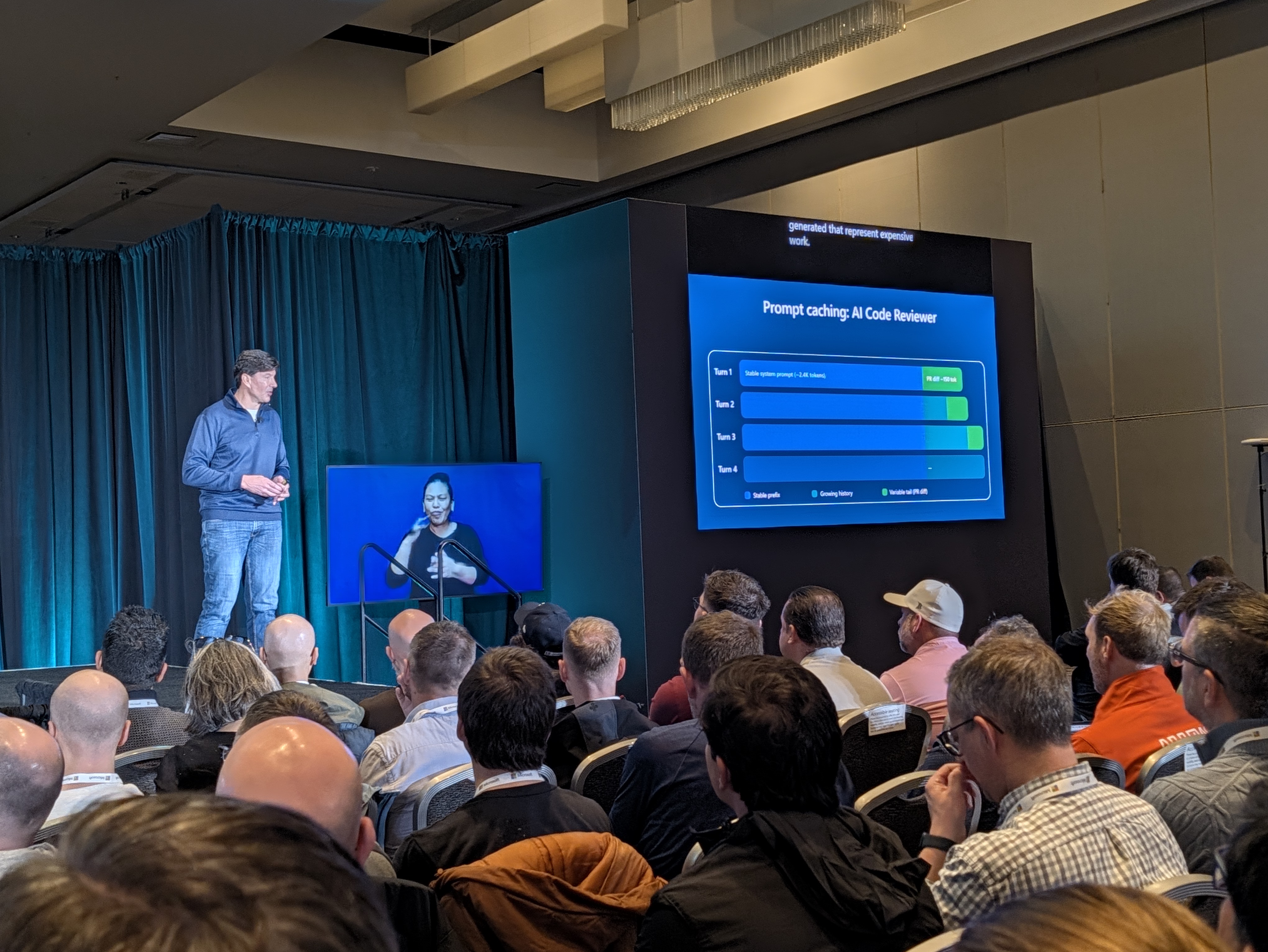
- Prompt caching: Using an AI code reviewer as an example, it became clear why naive multi-turn architectures burn money. Cache the stable prefix (a system prompt of around 2.4K tokens) once and only recompute the growing history plus the variable tail (e.g. a PR diff of around 150 tokens). This reduces latency and token costs.
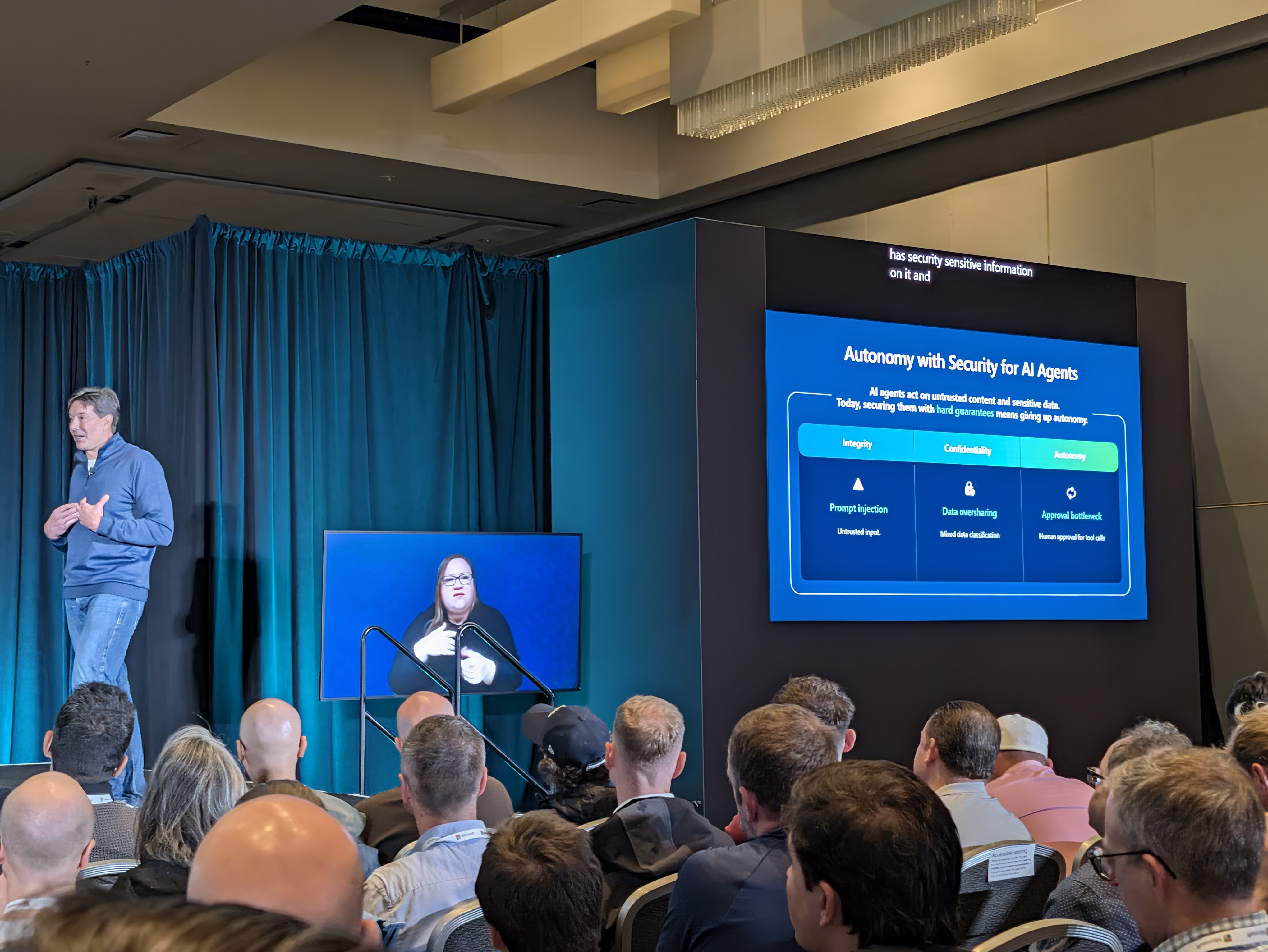
- Autonomy with security for AI agents: Integrity (prompt injection), confidentiality (data oversharing) and autonomy (the “approval bottleneck” when every tool call has to be approved) cannot all be maximized at the same time today. This is the core tension of agents in the enterprise.
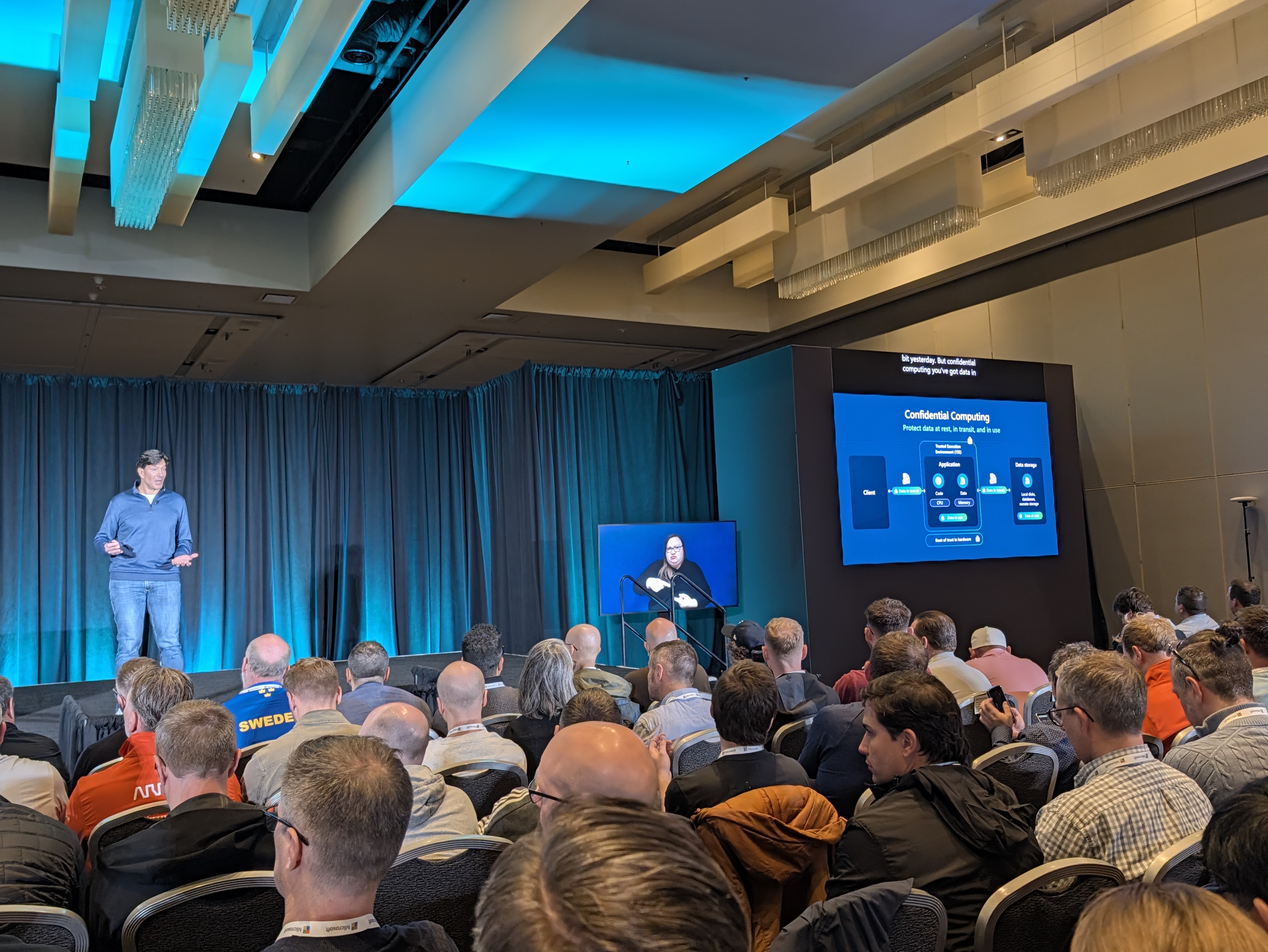
- Confidential computing (What’s new in Azure Confidential Computing – Ignite 2026): Encryption at rest and in transit is standard. With trusted execution environments and a hardware root of trust, data in use is protected as well, i.e. during inference in CPU and memory. I hope the topic gets much more attention and demand next year thanks to the sovereignty debate and the new extensions.
2. Azure SRE Agent: Azure operations with agents
The Azure SRE Agent has been generally available since March 2026, and I believe the topic will pick up a lot of speed next year. Microsoft itself mentions more than 11,000 agents running internally on top of the SRE Agent. I already use the SRE Agent in several customer environments. It can be real help for operational topics and, in autonomous mode, resolve incidents on its own.
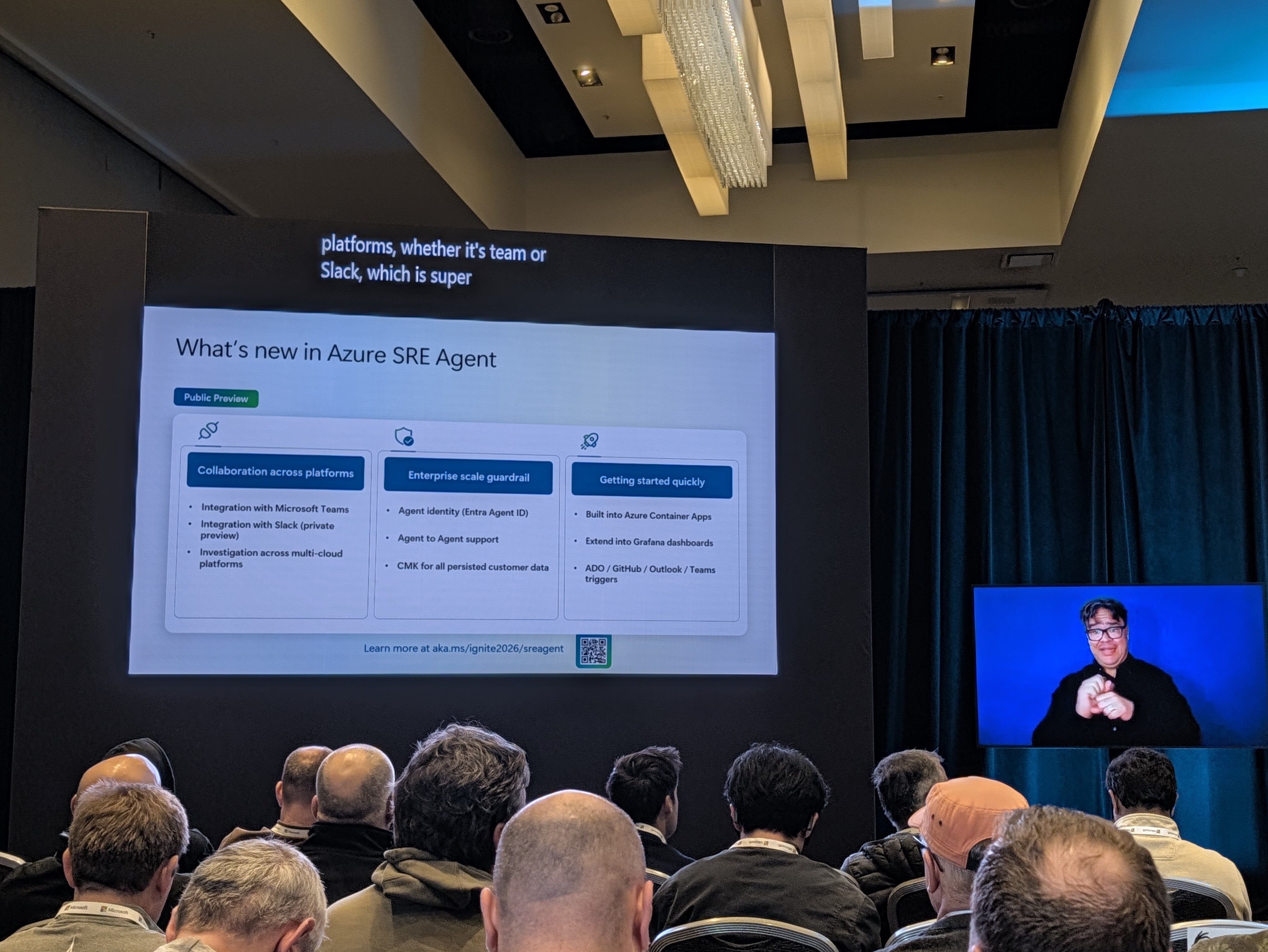
What surprised me: until now the SRE Agent ran with a managed identity. There was no identity of its own as an agent in Entra ID. That is changing now: every SRE Agent can get its own Entra Agent ID in addition to the managed identity (public preview). Azure roles can be assigned to the agent ID, and its actions appear in Entra and in the Azure activity logs as the agent itself. Honestly, I would have expected this to be there from the start. For operations in enterprises, clean identity and permission management is not a nice-to-have.
There were further news items, all in public preview for now:
- Integration with Agent 365 to manage and audit SRE Agents together with other agents
- Customer-managed keys for persisted customer data
- Agent-to-agent communication so that agents can share context and coordinate tasks
- Microsoft Teams as a work environment (Slack is in private preview), also for investigations across multiple clouds
3. Microsoft Perception: agentic security is GA
Fitting to that: “Project Perception”, which Microsoft introduced in July, has become Microsoft Perception with Ignite, and the platform is generally available. The approach is agentic: specialized agents work together in playbooks, security teams set priorities and approve critical actions.
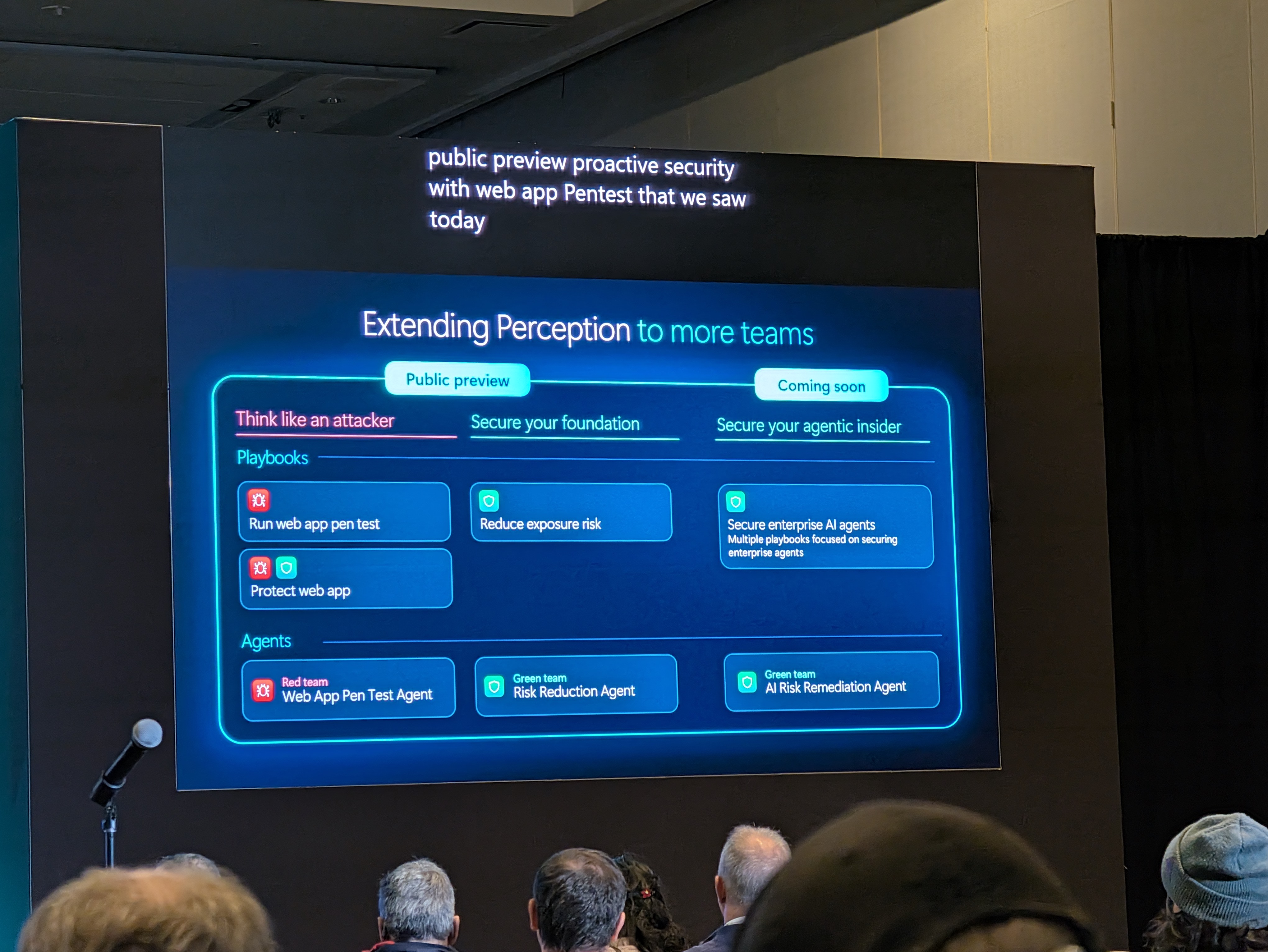
The distinction by status is important, because not everything is GA:
- GA: four blue team agents (Alert Triage, Attack Investigation, Detection Authoring, Threat Intelligence), the red team Recon Agent and the Posture Prioritization Agent
- Public preview: the Web App Pen Test Agent and the Risk Reduction Agent (including vulnerability shielding). The integrations with SIEM, SOAR and ITSM tools are in preview as well.
- Coming soon: playbooks to secure enterprise agents (“Secure your agentic insider”) and the AI Risk Remediation Agent
My favorite slide from the session was “Smarter model selection, better results”. Instead of using one large model for everything, each agent has a defined job, and candidate models are scored per task on quality, cost and latency. The best model runs the task. The evaluation keeps running as new models are released. Agents in the same playbook can therefore run on different models. For me this is a very practical answer to the question of how to keep AI costs under control in operations.
Azure Arc: TPM-backed identity for Arc-enabled servers
One item that easily gets lost in the keynote flood but matters for hybrid environments: the Azure Connected Machine agent will be able to use the physical TPM or a vTPM of the machine as a hardware root of trust (public preview). Until now, the credentials of the managed identity of an Arc-enabled server are stored on the local disk. With TPM-backed identity, the private key is sealed in the TPM and can no longer simply be copied from the disk. That is a clear gain for servers outside Azure that are not located in a protected data center. In addition, the preview includes a user-assigned managed identity for Arc-enabled machines, so that one identity can be granted permissions once and applied to many machines. Details can be found in the Azure Arc blog on Ignite 2026.
More news, briefly noted
A few more items from the Azure space that I marked (status according to Microsoft):
- Azure HorizonDB: PostgreSQL-compatible database for AI apps, generally available
- Azure Catalyst: agentic modernization of apps, data and infrastructure, from discovery and design to execution, also in GitHub Copilot. New in preview are the joint modernization of application and database and the migration from BizTalk to Azure Logic Apps. The blog does not state an overall status.
- Azure Copilot Deployment Agent: generally available, from a natural language requirement to deployment
- Azure Monitor Health Models: generally available
- ARM MCP Server: agents can not only read resources but also create and change them and trigger actions. The Azure permissions of the signed-in user apply, and Azure Policy applies to the resulting ARM calls. The Learn page does not state a status.
The people make Ignite
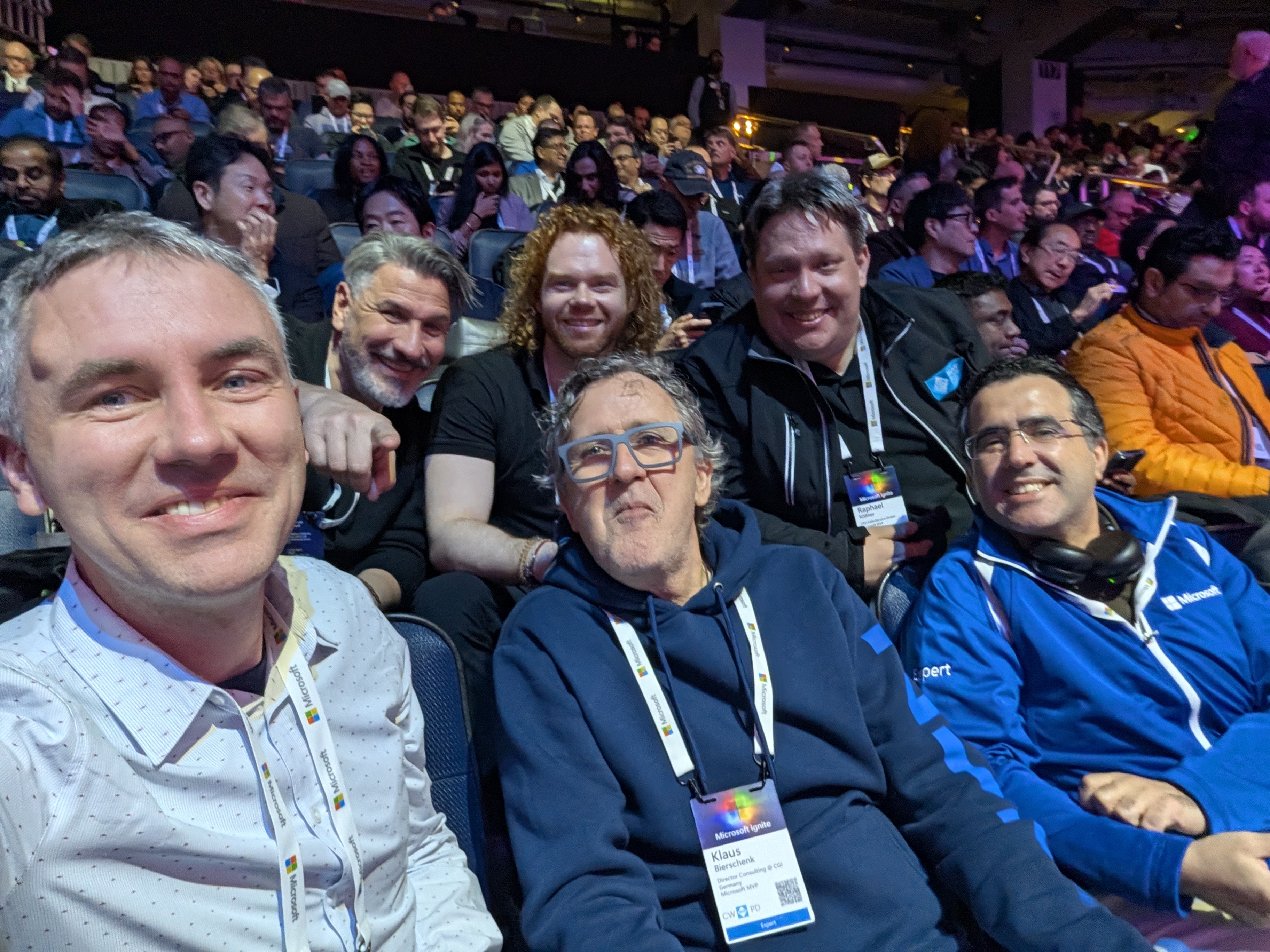
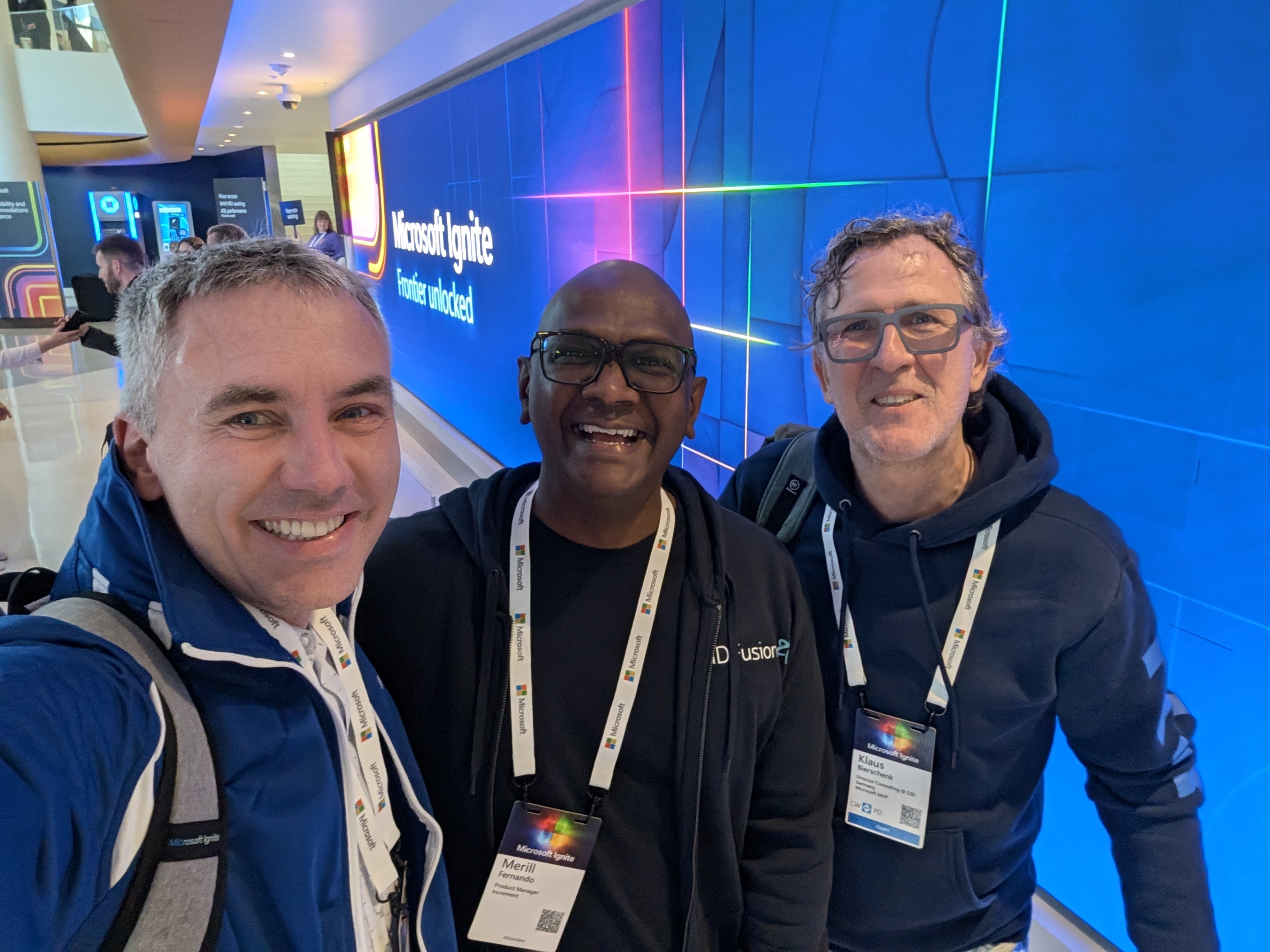
Technically the week was strong, but at least as important for me are the encounters. Traveling with MVP colleagues is always enormous fun. I thought it was really great to meet Merill Fernando, even if only briefly. Together with him and Klaus Bierschenk there was a selfie in front of the “Frontier unlocked” wall shortly before the keynote at the Chase Center. On the expo floor I met Chloe Mandell.
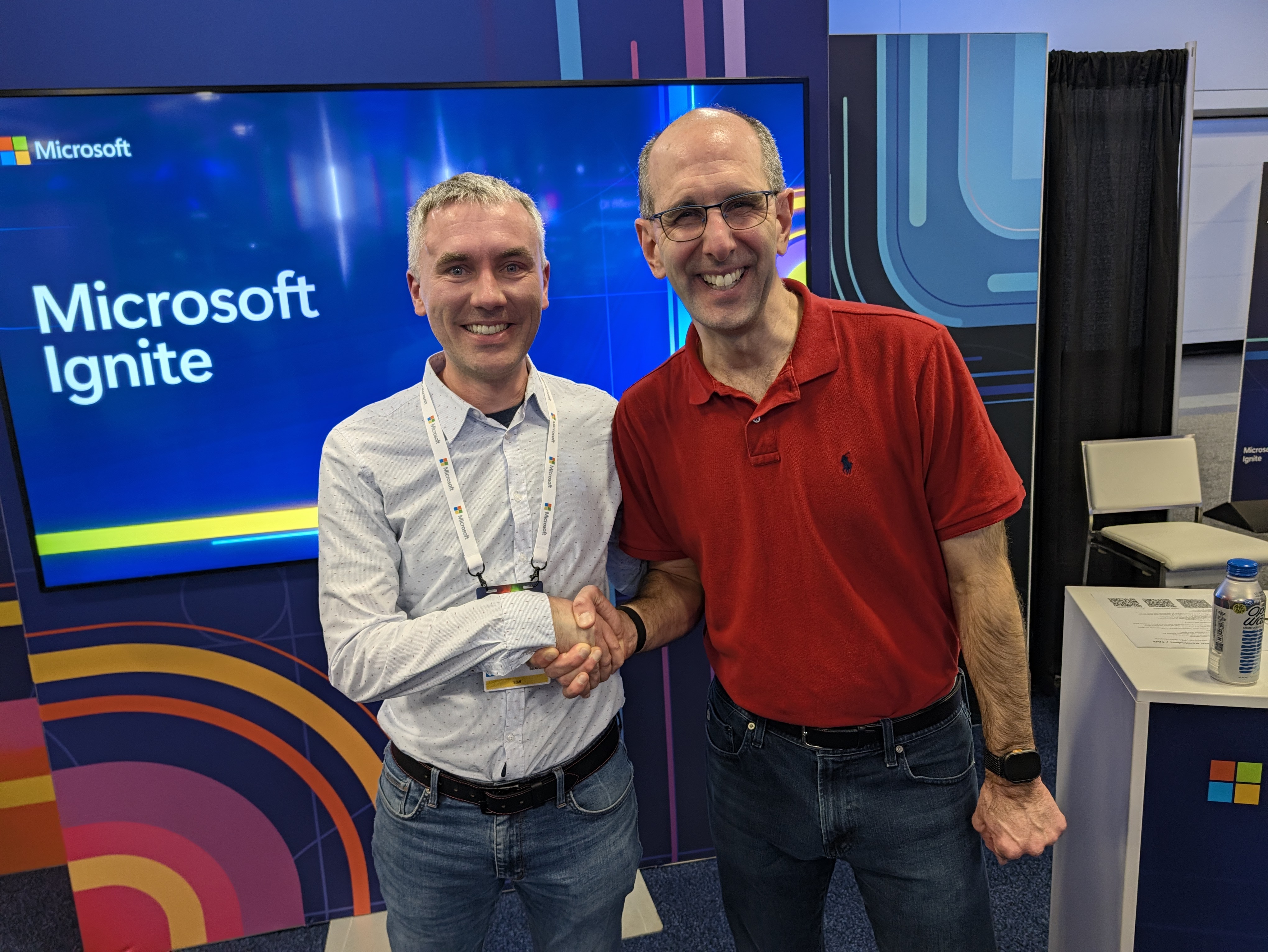
A special highlight: at Microsoft’s invitation I was able to take part in a special AMA session with Scott Guthrie, Executive Vice President of the Cloud + AI Group. The session covered the future of development, security topics and current capacity constraints. Infrastructure is being expanded especially there, and new technologies (see Azure Boost etc.) are being used to keep looking for ways to increase the available capacity. At the same time, it will remain necessary for the foreseeable future to check capacity in existing regions for new workloads and, where appropriate, to extend the landing zone concept to multi-region use. With Scott there was also a handshake photo in front of the Ignite screen.
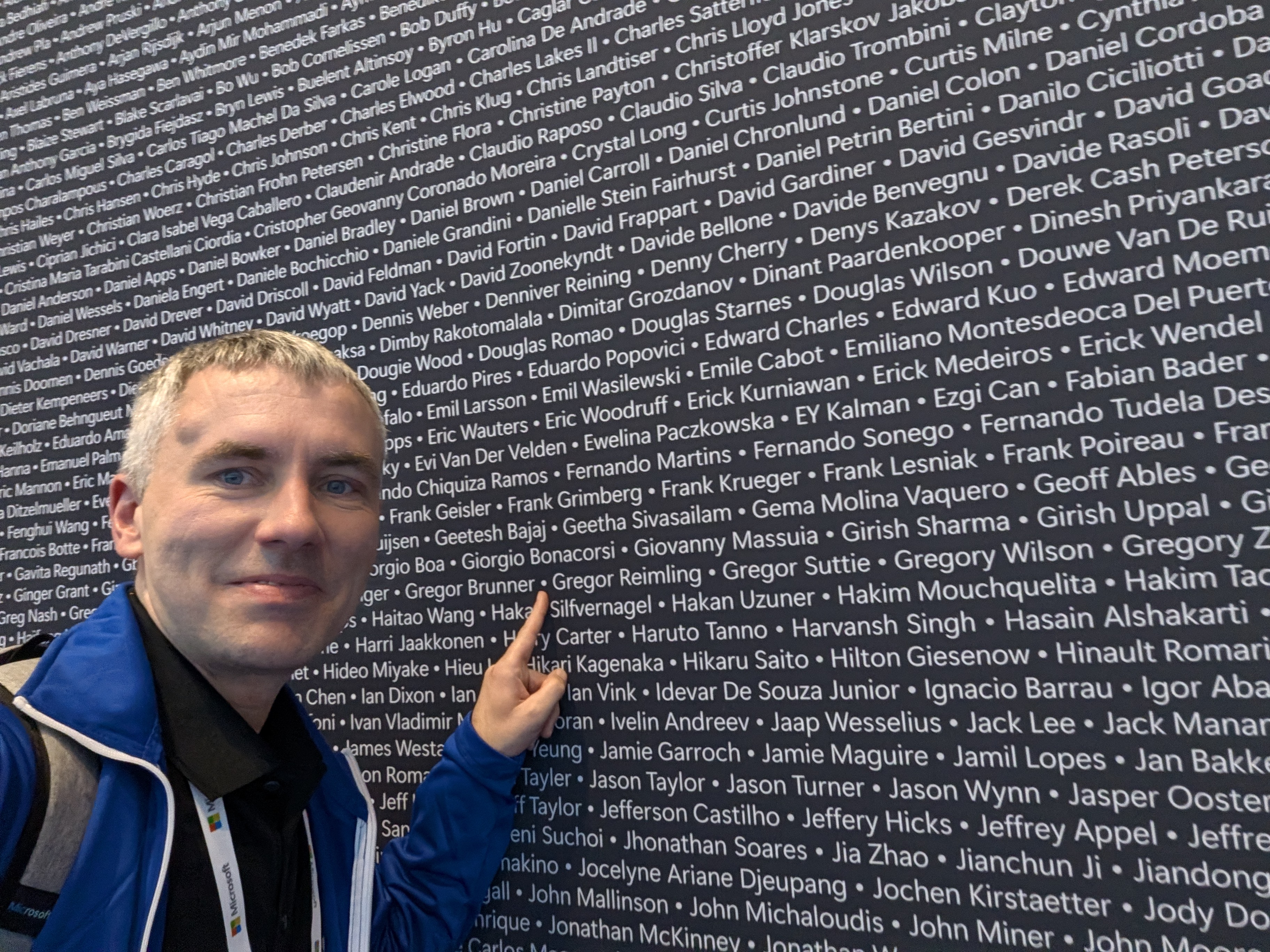
And of course the moment at the “Thank you to all Microsoft MVPs” wall: finding my own name among so many people from the community remains something special, and I am still grateful to be part of this community.
To finish, there was a group photo in front of the Ignite wall, among others with Raphael Köllner, a driverless Waymo ride through the Presidio and a few last looks at the Golden Gate Bridge. On the screen at the Moscone Center the invitation for next year was already up: See you back in San Francisco, 16–19 November 2027.
Conclusion
For me, Ignite 2026 showed where the journey in the Azure space is heading: the platform is being rebuilt specifically for AI workloads, operations are becoming agentic, and agents need their own identities and governance. At the same time, it pays to look closely at the status: a lot is GA, but many extensions are only in public preview.
If I had to take three recommendations for customers away from the week, they would be these:
- Actively deal with agents and how to secure them in Entra ID. Agents need their own identities, permissions and a lifecycle. Clarify this now and you save yourself sprawl later. Authentication belongs on the table here as well: SMS and phone calls as MFA methods have already been deprecated. What remains is MFA with number matching and passkeys, and in my view the phishing-resistant passkeys should become the standard for user identities. If you want to dive deeper into Entra and Agent ID, Thomas Naunheim’s Ignite 2026 Identity Recap offers a very detailed overview.
- Review your cloud resources regularly and modernize them. With Azure Boost, modernizing the Azure VM fleet becomes a must. Boost is only available from the v6 SKUs, older fleets do not benefit, and an upgrade is not easily possible because the storage controller changes from SSD to NVMe. Plan this as an ongoing topic from a performance and cost perspective.
- If you have operational challenges in Azure, take a look at the SRE Agent. Even in simple mode as a chatbot it can be helpful, and it is comparatively inexpensive. My article Hitzefrei for On-Call: Azure SRE Agent Takes the Shift helps with the setup. Another post about the SRE Agent follows on 14.12.
Ignite Recap at the Azure Bonn Meetup
If you would rather discuss all of this in person: next week we run the Microsoft Ignite Recap 2026 at the Azure Bonn Meetup.
- When: Tuesday, 1 December 2026, 6:00 pm to 9:30 pm
- Where: Comma Soft AG, Pützchens Chaussee 202-204a, 53229 Bonn, on-site only (no recording, no streaming). The meetup is held in German.
- Speakers: Thomas Naunheim (Microsoft Entra), Marcel Meurer (Microsoft VDI), René Wasel (Microsoft 365) and me (Azure governance and security), more speakers to follow
- Registration and details: Microsoft Ignite Recap 2026 on Meetup.com
I look forward to seeing you and discussing the highlights together.
Sources
Overview and session
- Microsoft Ignite 2026: What’s new in Azure, built for AI (Microsoft Azure Blog)
- Ignite 2026: The next era of enterprise AI starts with the infrastructure beneath it (Azure Compute Blog)
- Inside Azure innovations with Mark Russinovich, BRK542 (Microsoft Ignite)
Infrastructure and storage
- Announcing Public Preview of Guest RDMA for Azure Boost (Microsoft Tech Community)
- Public Preview: Azure Blob Storage turbo tier (Azure Updates)
- Public Preview: Distributed accelerator for cloud storage on AKS (Azure Updates)
- What’s New in Azure Confidential Computing – Ignite 2026 (Microsoft Tech Community)
SRE Agent, Perception and Arc
- Advancing agentic operations on Azure at Ignite 2026 (Microsoft Tech Community)
- Public Preview: Microsoft Entra Agent ID and Agent 365 for Azure SRE Agent (Azure Updates)
- What’s new with Microsoft Perception at Ignite 2026 (Microsoft Tech Community)
- Microsoft Takes Perception Agentic Security Platform Out of Preview (SecurityWeek)
- Govern, secure and operate anywhere with Azure Arc (Microsoft Tech Community)
More news
- Introducing Azure Catalyst: agentic modernization and new AI infrastructure innovations (Microsoft Azure Blog)
- Azure Resource Manager MCP server overview (Microsoft Learn)
Further reading